Bid Manager: What the Role Involves and How to Build a Bid Team Around It
What a bid manager does, the skills and salary to expect, and how bid teams win more proposals. A clear 2026 guide for bid and proposal teams.
A bid manager owns a company's response to a competitive tender, from the first bid/no-bid decision to the final upload. They build the schedule, track every requirement, shape the win strategy, and act as the last check before submission. The role is central to construction, IT, healthcare, professional services, and government contracting, where contracts are won through scored bids rather than direct selling.
In fact, about 20% of RFPs go unfinished by companies annually, leading to an average revenue loss of $725,000. Bid managers must tackle mounting pressure to deliver quality proposals faster.
If you are hiring rather than job-hunting, the section on how and when to hire the right role will help you decide which role to bring in first and where software replaces headcount.
This guide covers what the job involves day to day, the frameworks the work runs on, the skills and salary to expect, how a bid team is built, and how to move into the role. It is written for people entering the field and for teams standing up a bid function.
TL;DR
- A bid manager owns a company's response to an RFP, RFI, or tender: qualification, schedule, compliance, win strategy, and submission.
- In the US, bid managers earn about $73,000 to $122,000 a year depending on the source, sector, and seniority.
- If you are building a team, hire in sequence: a bid manager first, then a writer, coordinator, and capture manager as volume and deal size grow.
- Bid and RFP software covers content search, first drafts, and content upkeep, so a smaller team can run more bids. Hire people for judgment, use software for the repetitive work.
What is a bid manager?
A bid manager is the person accountable for a company's response to a request for proposal (RFP), request for quotation (RFQ), invitation to tender (ITT), or request for information (RFI). They pull input from sales, technical, legal, finance, and delivery into one compliant response that answers the buyer's evaluation criteria.
The role is often confused with the sales owner. Sales owns the client relationship and the commercial terms. The bid manager owns the process and the document: the schedule, compliance, win strategy, and the quality of every page. Most of that time goes to collecting input from busy experts and checking requirements, not writing.
Experienced bid managers follow a recognized method. Two are worth knowing: the Shipley process, which breaks the work into stages from opportunity review to post-submission analysis, and the APMP (Association of Proposal Management Professionals) framework, the industry's certification standard. Both exist because unstructured bids miss requirements, run late, and lose.
Bid manager vs. bid management: what is the difference?
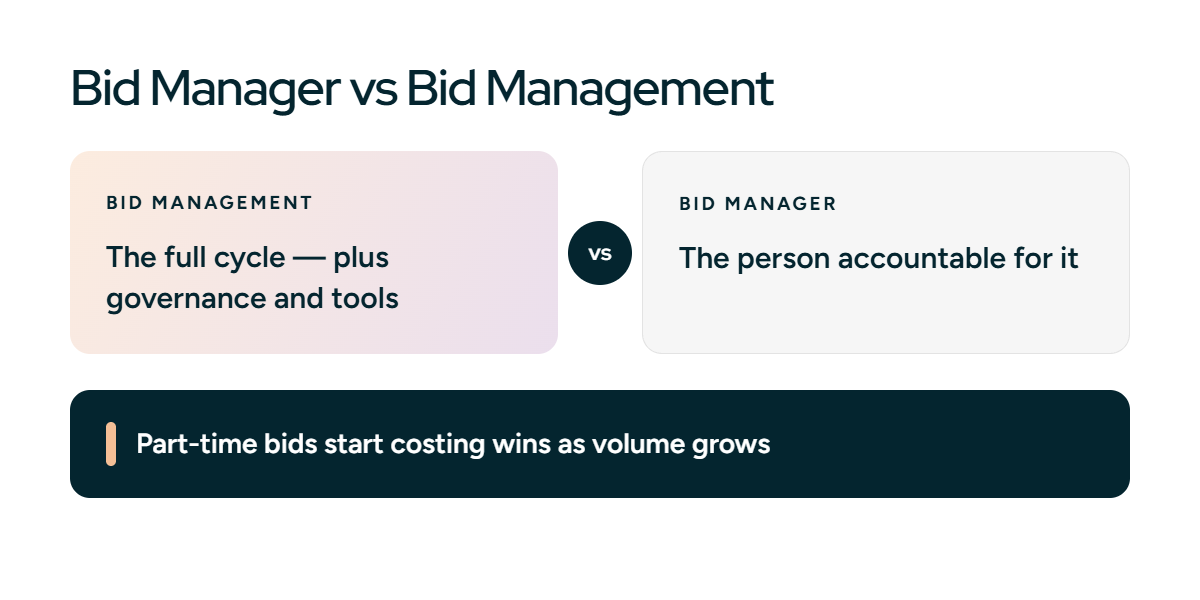
Bid management covers the full cycle of finding, qualifying, planning, writing, reviewing, and submitting competitive bids, plus the governance and tools that keep it consistent. A bid manager is the person accountable for that work on a given opportunity or portfolio.
Small teams often handle bids on the side, with sales or a manager writing them between other work. That works when bids are rare. Once bids become frequent or high-value, the part-time approach starts costing wins: deadlines get missed and responses go out rushed. That is when companies hire a dedicated bid manager to own the process.
Also Read: Bid Manager vs Proposal Manager
Bid manager job description
A bid manager job description sets out what the person owns and how their work is judged. The core is the same across every sector: take the opportunities worth bidding on and turn them into compliant, competitive responses that go out on time, and improve the win rate as you go.
Core purpose of the role
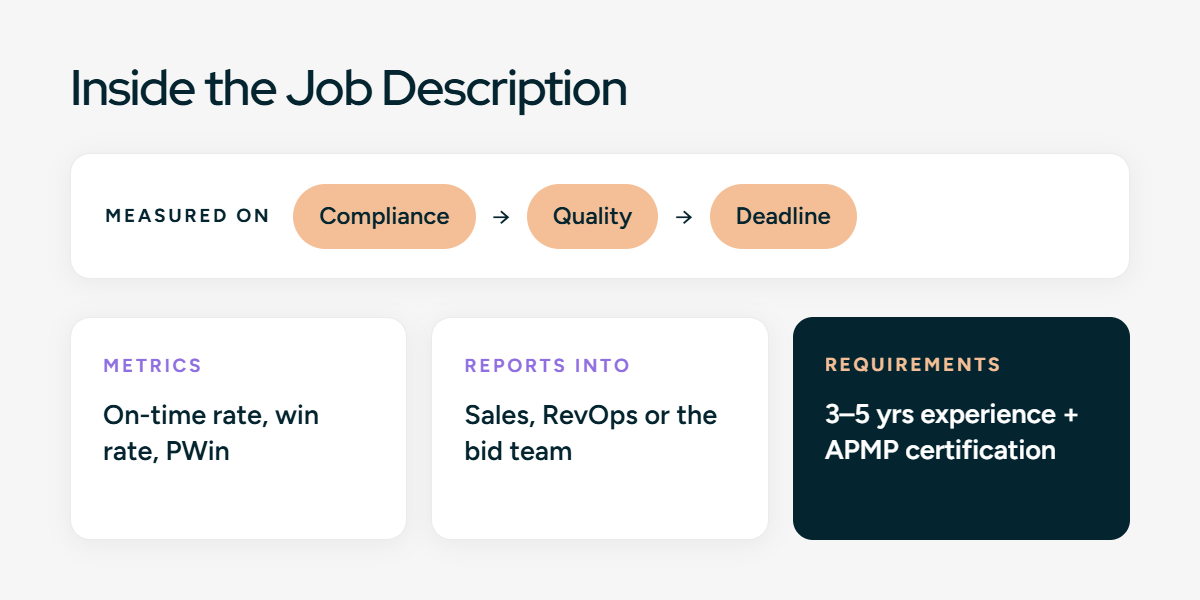
A bid manager is measured on three things, in order of priority: compliance, quality, and the deadline. Compliance comes first, because a response that misses a mandatory instruction is thrown out before anyone reads it. Quality means the response answers what the buyer scores, not what the company wants to say about itself. The deadline is fixed, because a late submission is usually rejected no matter how good the bid. The main performance metrics are on-time submission rate, win rate, and probability of win (PWin).
Where the bid manager sits
Bid managers usually report into sales, revenue operations, or a dedicated bid team. On larger deals, they report to a bid director, head of bids, or capture manager. The people they work with sit across the company: sales for deal context, subject matter experts (SMEs) for technical answers, legal for terms and risk, finance for pricing, and delivery for what the company can commit to. None of these people report to the bid manager, so the job runs on clear deadlines, follow-up, and the ability to get input from busy colleagues without formal authority.
Typical requirements and qualifications
Most roles ask for three to five years in proposals, bids, or capture, strong writing and editing, and a track record of hitting deadlines across a team. APMP certification (Foundation, Practitioner, then Professional) is the standard credential and is expected in senior roles. Job posts often name specific methods too, such as compliance matrices, color-team reviews, and the Shipley process.
A degree is usually preferred but rarely required when the experience is there. In government contracting, one thing sets candidates apart: knowing the FAR and how RFP Sections L and M work (the instructions for responding and the criteria for scoring). It matters because the response has to be written to match how it will be graded.
Bid manager roles and responsibilities
A bid manager's responsibilities run across the full lifecycle, from the decision to bid through the debrief.
Bid/no-bid: the decision that protects win rate
The bid/no-bid decision is the most important call a bid manager makes. Before committing the team, the bid manager weighs fit to the requirements, deal value and margin, the strength of the incumbent or competition, and an honest read on the probability of win. Bidding on everything lowers the win rate and drains SME time the next bid needs. Saying no to weak deals early keeps the team's hours on bids the company can win.
Requirements analysis and the compliance matrix
More bids are lost on missed requirements than on weak writing, because buyers screen out non-compliant responses before reading the content. To prevent that, the bid manager reads the full solicitation and builds a compliance matrix: every mandatory requirement, format rule, and submission instruction, each mapped to a section and an owner. In government bids, that means lining up Section L (how to respond) with Section M (how it is scored), so the response is written to the scoring.
Win themes and discriminators
A win theme is a specific, evidence-backed reason this buyer should choose this company for this contract. A discriminator is a strength competitors cannot credibly claim. Weak bids list generic capabilities; strong bids pick two or three win themes from the buyer's priorities and repeat them across every section. Each claim should follow a features-benefits-proofs structure: what you offer, why it matters to this buyer, and the evidence it is true. Claims without proof score poorly.
Color-team reviews
Color-team reviews catch problems while there is still time to fix them. A pink team checks an early draft for strategy and structure. A red team scores the near-final draft like an evaluator, flagging weak or non-compliant answers. A gold team is the executive sign-off; a green team reviews pricing. What matters is not the meeting but the rework it drives. A review that changes nothing in the document is wasted time.
The executive summary
The executive summary is written last but read first, and on many bids it is the only section a senior decision-maker reads in full. It should restate the buyer's problem in their own words, name the win themes, and make the case in a page or two. As the most-read part of the response, it deserves the bid manager's direct attention, not a rushed final draft.
Bid manager skills
The role rewards a specific mix of project discipline, persuasive writing, and commercial judgment. The skills below appear most often in job posts, and each one maps to a moment where bids are usually won or lost.
Bid manager salary
In the United States, a bid manager earns an average base salary of about $73,000 per year according to Indeed, and about $122,000 per year according to Salary.com (both September 2026). Real pay tracks sector, region, seniority, and the size of the bids managed.
Pay is highest in defense, construction, and enterprise technology, where deals are large and cycles are long, and in high-cost metros such as New York and Boston. The three levers that move earning potential most are APMP certification, a documented win rate, and experience on high-value or government bids, where one win can cover the cost of the role many times over.
Also Read: RFP Specialist Role, Importance and Salary
Bid team structure and roles
A bid team is the cross-functional group that produces a competitive response. On a small team, the bid manager covers most of these roles alone. As deal size grows, the roles split, and capture, the work done before the RFP is released, separates from proposal management, the work done after. The table shows a common mature structure and who owns what.
How to become a bid manager
Most bid managers arrive from proposal writing, sales support, capture, project coordination, or account management. No single degree is required, but hands-on bid experience and a record of hitting deadlines are. The route below is the most common, and it usually takes a few years rather than a single promotion.
- Get on live bids in a writing, coordination, or sales-support role, where you see the full process up close.
- Learn the lifecycle by doing it: bid/no-bid, compliance matrices, win themes, color teams, and submission.
- Earn APMP certification, starting at Foundation and moving to Practitioner, to put a recognized name to the skill set.
- Own small bids end to end, then take on larger, multi-contributor, higher-value ones.
- Track the win rate and total value of the bids you have run. That record is what moves you into senior or capture roles.
Challenges bid managers face in 2026
The core of the role is steady, but the pressure around it has risen: buyers want more detail, in less time, with tighter scrutiny on security and compliance. The common challenges are below, each with the fix experienced teams use.
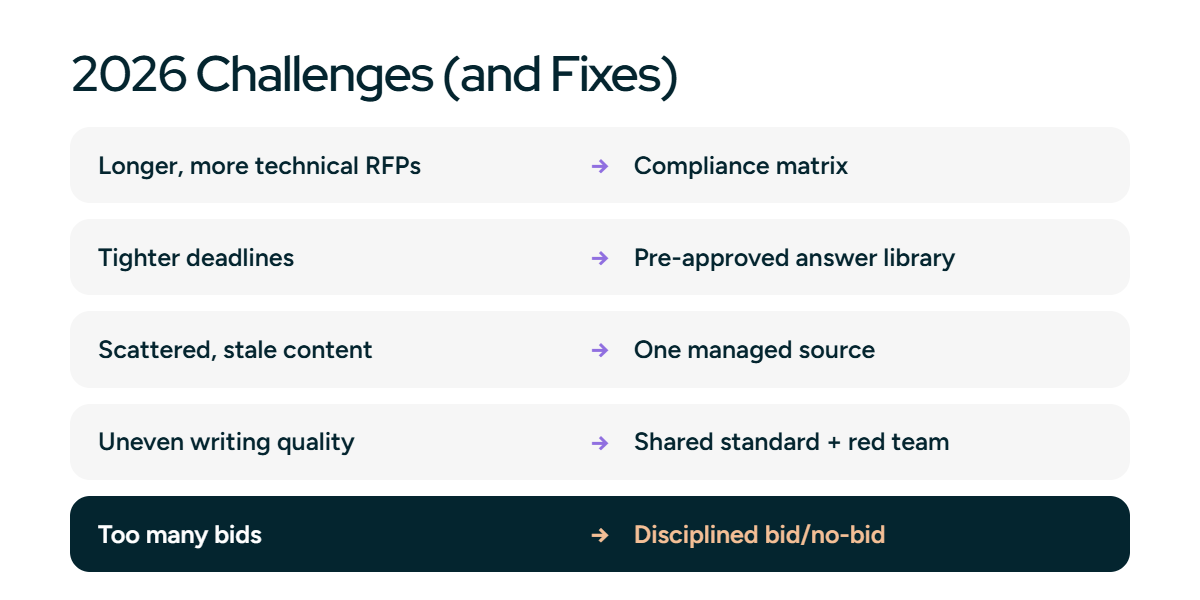
- RFPs are longer and more technical. A single RFP can span several documents, each with its own security, legal, and technical requirements. It is easy to miss one. Building a compliance matrix on day one, which maps every requirement to an owner, makes sure nothing is missed in the final week.
- Deadlines are tighter. Buyers give anywhere from a few days for a short RFI to a few weeks for a large bid, and they rarely grant extensions. Keeping a library of pre-approved, up-to-date answers means the team can respond fast without cutting corners on quality.
- Content is out of date and scattered. Answers sit across drives, inboxes, and old proposals, and an answer that was correct last quarter may be wrong today. Keeping content in one managed source, with a clear owner for each answer, removes the risk of sending outdated information and the scramble to fix it late.
- Writing quality varies between contributors. When several SMEs write sections, the tone drifts, and some claims go unsupported. A shared features-benefits-proofs standard, plus a red team review before submission, brings the whole document back to one clear voice that answers what the buyer scores.
- Too many bids at the same time. Overlapping deadlines stretch the team thin and pull effort toward deals the company is unlikely to win. A disciplined bid/no-bid process and a shared tracker keep the team's time on the bids actually worth winning.
How (and when) to hire the right role for your organization
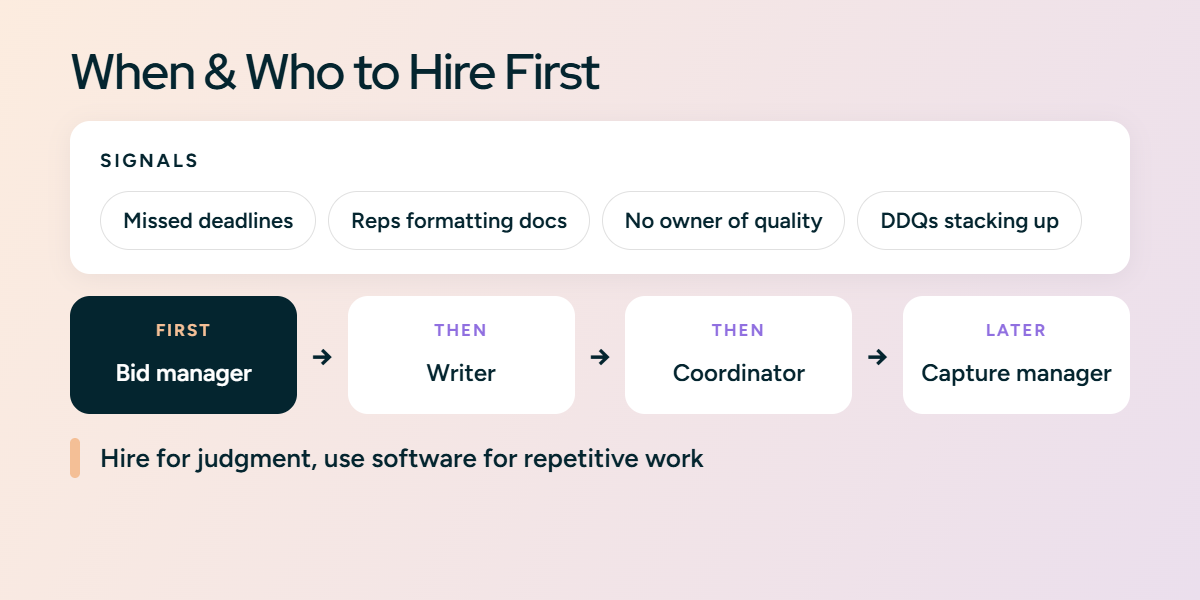
Most companies do not start with a bid team. They start with sales handling bids on the side, then hire once the volume or the stakes get too high. The question is which role to hire first, and when. Bringing in the wrong role, or hiring too early, wastes budget. Waiting too long costs winnable deals.
Use these signals to decide when to make the first hire:
- You are losing good opportunities to missed deadlines or rushed responses.
- Senior salespeople are spending nights and weekends formatting documents instead of selling.
- Bid volume is rising and no single person owns quality or compliance.
- Security questionnaires and DDQs are stacking up with no clear process.
When those signals appear, hire in this order as the function grows:
Headcount is not the only lever. Bid and RFP software handles content search, first drafts, and content upkeep, which is where most of a team's manual hours go. That means one bid manager can run the volume that used to need two or three people. The practical rule: hire people for judgment, such as strategy, qualification, and buyer relationships, and use software for the repetitive drafting and content maintenance.
For mid-market and enterprise teams facing a steady flow of RFPs, RFIs, and security questionnaires, a platform like Inventive AI lets teams keep quality high without adding headcount for every extra bid.
How bid management software helps bid managers
Two tasks take up most of a bid manager's time: finding accurate content and writing a compliant first draft before the deadline. Most of it goes into digging up the right past answer, rewriting it for the current buyer, and checking it is still correct. Bid and RFP software handles that work, so the team can run more bids without adding headcount, and the bid manager can spend the saved time on strategy and review.
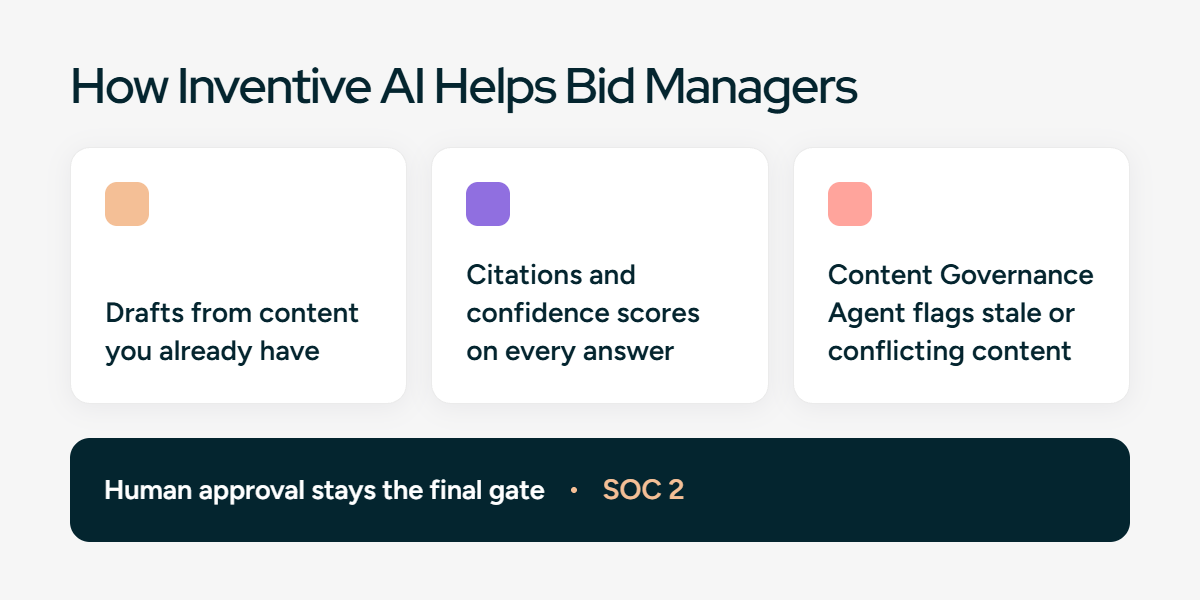
Inventive AI is an AI-native RFP software platform for automating RFPs, RFIs, and security questionnaires. For a bid manager, three parts of it matter most:
- Drafts from content you already have. It connects to SharePoint, Google Drive, Salesforce, and Confluence and drafts answers straight from that content, so no one has to build and maintain a separate answer library.
- Citations and confidence scores on every answer. Each answer shows its source and a confidence score, which speeds up the compliance check and the review.
- Content Governance Agent. It flags outdated, duplicate, or conflicting content before it reaches a buyer, the direct fix for the stale, scattered answers that slow most teams down.
Every response still goes through human approval, so the bid manager stays the final gate. Inventive AI is rated highly on Gartner and G2 for AI response quality and holds SOC 2 certification, which matters when bids involve security questionnaires and enterprise buyers.